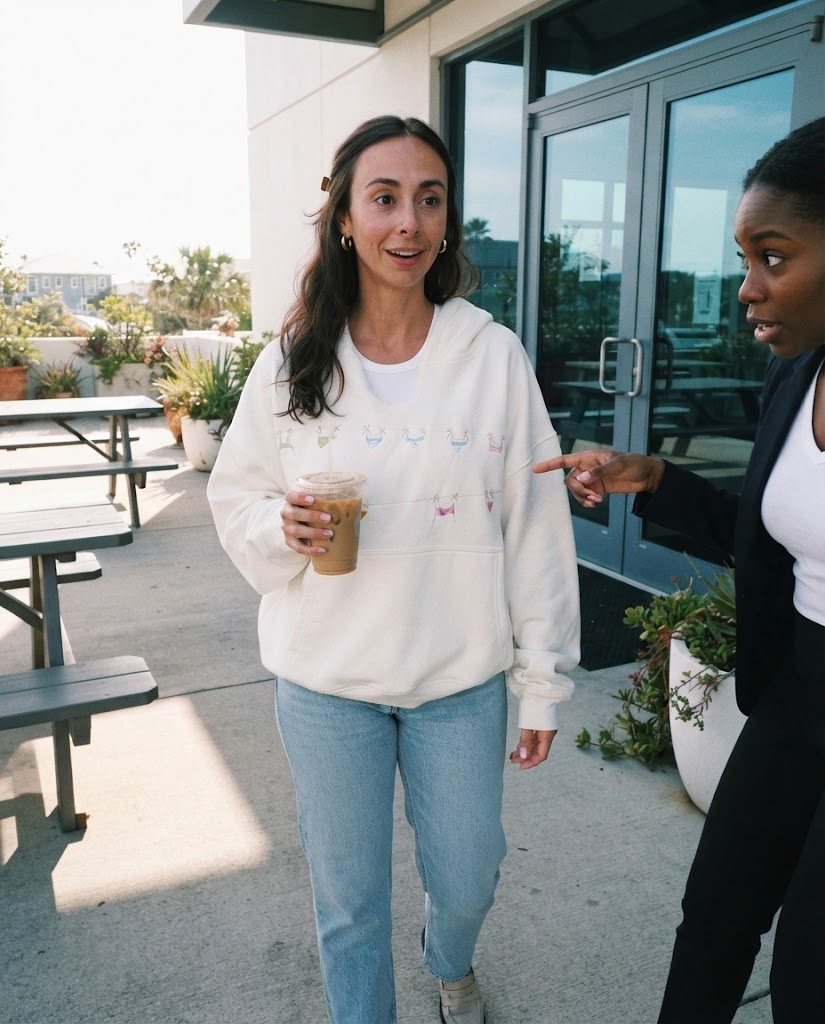
The Social Discovery Beach Hoodie
I just figured out why my friend sent me this hoodie at midnight, and now I understand the matching photos.
My friend sent me a link at 11:47 p.m. with no explanation, just three words: “This is us.”
I almost ignored it because my phone was at 8 percent, my suitcase was still open on the floor, and I had already bought one beach hoodie that looked nothing like its photos.
But then I saw the pictures. Two women in oversized white hoodies, iced coffees in hand, standing under a striped beach umbrella like they had accidentally walked into the exact vacation mood they had been talking about for six months.
The detail that got me was not even the matching part. It was the tiny rows of colorful beach pieces across the front, little swimsuits and summer shapes in soft pink, blue, yellow, and green. It looked playful without looking like something a teenager would wear to a theme park.
I have one friend who is always cold. You know the type. She brings a cardigan to restaurants in July, keeps a sweatshirt in her car, and asks for the seat farthest from the air conditioner before she even looks at the menu.
I am not quite that bad, but beach mornings get me every time. The sun is out, everyone is excited, and I am standing there in a bikini with goosebumps, trying to pretend I am not borrowing someone else’s towel to cover my shoulders.
Then there is the airport version of the same problem. You want to start the trip in a cute outfit, but you also need something soft for the flight, something that works over swimwear, and something you will not hate carrying around once the temperature climbs.
My usual solution was to pack three random sweatshirts and hope one of them looked okay in a photo. It never did. One was a faded college sweatshirt from 2018. One had a hood so thin it collapsed around my neck. The third was a $42 fleece pullover that was cozy for exactly two washes before it started pilling under the arms.
I also bought a $31 cropped hoodie from a fast-fashion site because the model looked adorable in it. In real life, the fabric felt papery, the sleeves stopped above my wrists, and the hem rode up every time I lifted my arms. It was technically a hoodie, but it did not make me feel ready for a beach day.
The worst purchase was a $58 “vacation” sweatshirt with a giant neon graphic across the chest. It arrived in a plastic bag smelling strongly of dye, and the graphic was already cracking along the edge. I wore it once on a chilly boat ride, spent the whole time tugging at the sleeves, and donated it before the next trip.
So when my friend sent the link, I replied, “Is this actually cute in person?” She said, “I saw it on two girls in my group chat. They both bought it for their beach trips. The back is the best part.”
That was enough to make me open it, but not enough to buy it. I checked the photos, zoomed in on the stitching, read the size notes, and closed the page. Then I opened it again ten minutes later.
I was mostly deciding whether I wanted the hoodie or the idea of the hoodie. The idea was easy. Matching with my friend, walking to coffee by the water, wearing it over a pink bikini, taking the kind of pictures we usually only save to our camera rolls.
The hoodie itself had to survive real life. It had to be roomy without making me look swallowed, soft without feeling thin, and interesting enough that I would actually reach for it instead of the same gray sweatshirt I wear every week.
I left it in my cart overnight. The next morning I saw the page again because my friend had sent it to another person in our group chat. “We need these for the May trip,” she wrote. At that point, it felt less like an ad and more like one of those things that quietly moves through a friend group before you realize everyone has seen it.
I ordered one for myself and one for her. Not because I suddenly trusted every clothing website, but because the design felt specific. The little beach-club-style illustrations were embroidered across the front in neat rows, and the back carried the larger seaside scene with palm trees, a pastel beach hut, and tiny colorful details that made you want to look twice.
When the package arrived, I opened it on my kitchen counter before I had even taken off my shoes. The first thing I noticed was the weight. It was not a flimsy layer pretending to be a sweatshirt. It had enough body to hold its shape, but it was not stiff or bulky.
The inside felt soft against my wrist. The hood had structure instead of falling flat, the ribbed cuffs sat securely at my hands, and the kangaroo pocket was actually large enough for my phone and room key. The white color was clean and warm, not a harsh blue-white that made the embroidered colors look cheap.
I put it on over bike shorts just to check the fit. The shoulders dropped naturally, the sleeves covered my wrists, and the hem landed around the upper hip. It was relaxed, but not so oversized that I disappeared inside it.
Then I turned around in the mirror. That was the moment I understood why my friend had said the back was the best part. The palm trees and pastel beach hut gave it a little story. It looked like a souvenir from a place I wanted to be, not a random logo printed on a sweatshirt.
I did not take a mirror selfie. I just stood there for a second, looking at it with the strange satisfaction of finally finding the version of a vacation layer I had been trying to buy for years.
The first real wear was a Saturday morning at the beach. My friend and I had planned to grab coffee, walk along the water, and take a few pictures before meeting everyone else. The air was cooler than expected, so we pulled the hoodies over our swimsuits and headed out.
A woman in line behind us pointed at the front embroidery and asked where we got them. Then she noticed the back of mine when I turned around and said, “Wait, there is more on the back?”
That was the first compliment. The second came from the barista, who said, “You two look like you planned that,” even though we had mostly planned not to be cold.
By the time we reached the sand, my friend had received a message from her sister asking for the link. I sent it to her, then sent it to my cousin because she is the person who starts planning summer before spring has even arrived.
That afternoon, my friend posted one photo from under the beach umbrella. Within an hour, three people asked about the hoodies. One wanted to know if they ran oversized. Another asked whether the colors looked as bright in person. Someone else said, “I need the one your friend is wearing,” because the backs were slightly different in the photo angle.
It kept happening in small, normal ways. My roommate borrowed mine for a grocery run and came back wearing it with loose linen pants. My mom saw the beach illustration and said it would make a cute gift for the friend who is always cold. A girl from college sent me a screenshot and wrote, “This is so you.”
That last message stayed with me because it was exactly what my friend had said the night she sent the link. Not “this is trendy.” Not “this is on sale.” Just, “This is us.”
I started thinking about all the clothes I had blamed myself for not styling correctly. The stiff sweatshirt. The tiny cropped hoodie. The loud vacation pullover. I thought I was bad at buying casual clothes, or maybe that my body was the reason the fit looked wrong.
But the problem was not my body. It was that I kept buying generic versions of something I wanted to feel personal. I wanted a layer that could be warm and comfortable, but still say I am going somewhere fun. I wanted to stand out without looking like I had tried to dress for attention.
One right piece did more for my suitcase than the three cheaper sweatshirts I had bought before it. It worked over a swimsuit at the beach, over a tank for coffee, and with loose pants on the flight home. That $68 purchase replaced the pile of wrong layers I had spent more than $130 collecting.
The hoodie is from Hailey Lane, and it makes sense why it started with a friend sending a late-night link. It feels like the kind of thing people share because they can already picture someone they know wearing it.
The design is made for the girl counting down to summer, the girl who books the beach house in January and starts a vacation packing list before she knows what the weather will be. It is also a very easy gift for the girl who is always cold, especially if you add a small beach accessory and make the whole thing feel intentional.
There is a matching mom-daughter angle too, without forcing both people into identical outfits. Two hoodies in the same cream color, the same tiny rows of beach embroidery, and suddenly the airport or boardwalk pictures feel like a memory instead of a posed campaign.
This is a small-batch style, so the size and color mix can change between runs. My friend found it through someone else, I found it through her, and now two more people in our group have it saved for their next trip. That is usually how the good vacation pieces move, quietly, person to person.
If you have been counting down to summer, or you already know exactly who needs a hoodie because she is cold in every restaurant, this is the part where I would look before the next batch is gone. There is free US shipping and 30-day returns, which helped me feel less ridiculous about ordering after being burned by the last three.
I thought I was buying a sweatshirt for chilly beach mornings. I did not realize I was buying the piece that makes the trip feel like it has already started.
haileylane.com
Settings that produced this
| Angle | The Social Discovery Beach Hoodie |
| Avatar state | Social Discovery |
| Beliefs hit | Belief 1, Belief 3, Belief 4, Belief 5, Belief 6 |
| Garment analysis | This is a cream-white oversized pullover hoodie with dropped shoulders, long sleeves, ribbed cuffs, a structured hood, and a kangaroo pocket. The front has neat rows of small pastel embroidered beachwear and seaside motifs, while the back has the stronger large illustration: green palm trees framing a pastel pink-and-tan beach hut with colorful surf-inspired details. |
| Image model | nano-banana-2-lite |
| Credits | 4 |
| Generated in | 140s |
| Words of copy | 1760 |
| Image prompt | Reference 1 = the product (front and back views). Match exactly: cream-white oversized pullover hoodie with a relaxed dropped-shoulder silhouette, long sleeves with ribbed cuffs, structured hood, kangaroo pocket, colorful embroidered rows of tiny beachwear and seaside motifs across the front, and a larger pastel beach-hut scene with green palm trees, pink and tan details, and surfboard-like accents on the back. Change: model, setting, lighting, angle, composition, pose. Render the back side faithfully because the larger beach illustration is the stronger design. SCENE — A real beach-trip morning on a Florida boardwalk near the sand, the woman has just stepped away from a striped green-and-cream beach umbrella with an iced coffee in one hand and the hoodie worn over a pink bikini, turning slightly so the back artwork is visible while her friend reaches toward the hood. PERSON — Age 27, Latina, real midsize body with natural proportions, lived-in long dark hair partly tucked behind one ear with loose strands moving in the sea breeze, relaxed half-smile and slightly squinting eyes, casual excited vacation energy, not posed like a model. SHOT TYPE — Three-quarter body phone photo from a slightly off-center side angle, the back of the hoodie clearly visible, friend partly cut off at the edge, uneven framing with the umbrella and palm trees taking up the upper background, no straight-on centered portrait, phone not visible. CAMERA SPECS — Shot on an iPhone X, 2018. Portrait mode OFF, so the background is as sharp as she is. Grain in the shadows. iPhone JPEG compression. Not a DSLR, not a mirrorless, not a studio. LIGHTING — Plain natural late-morning beach light from camera left, bright but slightly uneven, soft shadow from the umbrella across part of the hoodie, no ring light, no flash, no softbox. COLOR GRADING — None. Straight off the camera roll, unopened in any editor. Not VSCO. Not Lightroom. AUTHENTICITY SIGNALS — Motion blur on the loose hair strand, slight fabric crease at the elbows and lower back, weight shifted into one leg, mundane paper coffee cup and folded beach towel visible near the umbrella pole. NEGATIVES — No studio lighting. No ring light. No white backdrop. No model pose. No heavy bokeh. No airbrushed skin. No symmetrical composition. No stock photo framing. No text or watermark. Do not alter the cream color, hood shape, embroidery placement, or back illustration. VIBE LINE — This looks like she texted it to her sister asking if the back design is cute enough for the beach trip. SHOT ON AN OLD PHONE, NOT A CAMERA. This is a snapshot taken on an iPhone X in 2018 and never edited. Nobody was paid to take it. CAPTURE: hand-held with a slight tilt, subject off-centre, a limb or the top of the head clipped by the frame edge. Slight motion blur on a hand or a strand of hair. Focus landing slightly off, on a shoulder or the background rather than the eyes. SENSOR: visible luminance noise in the shadows and in dark fabric, narrow dynamic range so a window or the sky blows out to white while shadows crush to near black, mild chromatic aberration on high-contrast edges, fine detail smeared by the phone's own noise reduction, visible JPEG compression in flat areas. SKIN AND HAIR EXACTLY AS THEY ARE: visible pores and texture, uneven tone, some redness, natural under-eye shadow, minor blemishes, flyaway hairs, asymmetry. No smoothing, no slimming, no whitening. SOMETHING MUNDANE IS IN FRAME: a used mug, keys, a charging cable, a crumpled towel, laundry on a chair. Real rooms are not tidy. NEGATIVES, all hard: no portrait mode, no background blur, no bokeh, no HDR, no tone mapping, no filter, no preset, no colour grading, no ring light, no studio or softbox lighting, no flash, no rim light, no sharpening halos, no glossy highlights on skin, no symmetrical or centred composition, no posed model stance, no stock-photo framing, no empty styled background, no text, no watermark, no logo overlay, no CGI or 3D-render look, no airbrushing, no professional-photo quality. If it could pass for an ad, it is wrong. It should look like a friend took it without paying attention. |